For modern homeowners, few property management emergencies trigger as much immediate anxiety as a backed-up main sewer line. Beyond the unpleasant aesthetic and sanitary consequences inside the home, the realization that the subterranean infrastructure connecting your dwelling to the municipal sewer line has compromised structural integrity can be daunting. Historically, fixing a collapsed, severely cracked, or root-choked lateral sewer pipe meant turning your front yard into a construction zone by destroying manicured lawns, tearing through custom flagstone walkways, splitting asphalt driveways, and disrupting household life for days or even weeks.
However, advances in trenchless technology over the past two decades have fundamentally shifted how utility contractors approach underground pipe replacement. Chief among these innovations is trenchless pipe bursting, a modern method designed to replace failing underground pipes without digging continuous trenches across private property. Yet, despite its rapid adoption, pipe bursting is not a universal magic bullet. Certain geotechnical conditions, structural collapses, and municipal regulations still make open-trench excavation the necessary choice.
The Reality of Main Sewer Line Failures in Mature GTA Neighbourhoods
To understand why modern replacement methods are in such high demand, one must first look beneath the surface of the region’s historical housing stock. The Greater Toronto Area is defined by decades of urban expansion, featuring established neighbourhoods built throughout the late 19th and mid-20th centuries, such as High Park, Cabbagetown, The Annex, Old East York, and inner-ring suburbs in Mississauga, Scarborough, and Etobicoke. While these communities boast mature tree canopies and architectural character, their below-ground infrastructure is reaching the end of its design life span.
Prior to the mid-1970s, residential sewer laterals were constructed primarily using two materials: vitrified clay pipe (VCP) and cast iron pipe. In older homes dating from the post-WWII housing boom up to the 1970s, contractors frequently used bitumenized fiber pipe, commonly known as “Orangeburg”. Each of these legacy materials suffers from predictable structural degradation patterns over time:
- Vitrified Clay Pipe (VCP): Clay pipe is inherently brittle. Over 50 to 100 years, soil settlement, seismic vibrations from nearby road traffic, and seasonal freeze-thaw cycles cause clay pipes to shift, crack, and separate at their mechanical joints. These open joints emit moisture and nutrient scents that act as magnets for aggressive tree roots. Once roots enter the pipe, they expand, catching debris and causing recurring blockages before ultimately breaking the pipe apart.
- Cast Iron Pipe: While cast iron exhibits excellent initial tensile strength, it suffers from tuberculation and interior scale buildup over decades of wastewater exposure. Moisture and hydrogen sulfide gas lead to channel rot along the bottom (invert) of the pipe, thinning the metal until the base corrodes away entirely, allowing soil to slump into the sewage flow.
- Orangeburg Pipe: Made from compressed wood fiber impregnated with coal tar, Orangeburg pipe was a low-cost material that was never designed for multi-generational performance. Under decades of ground pressure, these pipes blister, flatten into oval shapes, layer-delaminate, and suffer complete structural sewer failure.
When an underground conduit experiences structural breakdown, standard drain snaking or high-pressure hydro-jetting offers only temporary relief. These clearing techniques remove organic clogs or cut back root masses, but they do not repair broken walls or realign offset joints. Once a line has suffered true structural decay, full physical replacement of the lateral sewer line repair target becomes unavoidable. The question then becomes how best to execute that replacement with minimal secondary loss to property value.
Understanding Traditional Sewer Excavation
Traditional sewer excavation, often referred to as the “open trench” method, has been the standard construction practice for over a century. The core operational logic is straightforward: to replace an underground pipe, technicians must dig open the earth directly above it along its entire trajectory, from the exterior foundation wall of the home to the municipal main connection at the property line or curb.
The process begins with utility mark-outs (locating underground gas, hydro, and telecommunication lines) followed by the deployment of heavy excavation machinery. A track excavator or backhoe is positioned in the yard to break through surface paving and dig a trench typically 4 to 10 feet deep and 3 to 5 feet wide, depending on the depth of the local municipal sewer infrastructure.
During an open trench excavation extending 80 linear feet at a depth of 6 feet, over 70 tons of earth must be removed, stockpiled, and later backfilled. In narrow urban lots, this frequently requires hauling soil off-site temporarily due to spatial constraints, increasing overall operational costs.
Once the legacy pipe is completely uncovered, workers enter the trench (utilizing trench shoring boxes if required by occupational safety standards) to manually break apart the old conduit, discard the degraded materials, and clear the trench bed. A new bed of aggregate gravel is carefully graded to ensure the proper pitch, typically a minimum of a 1/4-inch drop per linear foot, to guarantee gravity-driven sewage flow. The replacement pipe, usually rigid Polyvinyl Chloride (PVC) schedule 40 or 80, is then assembled piece-by-piece, solvent-welded or mechanically coupled, inspected by municipal staff, and finally backfilled with soil before mechanical compaction.
While open trenching allows contractors to visually inspect the entire length of the exposed line and correct adverse slope issues, its physical impact on the surrounding property is severe. Driveways are jackhammered, mature decorative trees and established gardens are uprooted, retaining walls are disrupted, and porch steps may need structural underpinning if the trench runs immediately adjacent to foundations.
Understanding Trenchless Pipe Bursting
Trenchless pipe bursting was developed specifically to eliminate the destructive footprint associated with open-trench excavation. Rather than digging up the entire length of the subterranean pipe, pipe bursting utilizes the path of the existing, degraded sewer line to install a brand-new, seamless pipe directly through the space occupied by the old one.
Instead of continuous trenching across the yard, pipe bursting requires only two small excavation access points:
- The Insertion Pit: A small pit (typically 4×4 feet) dug near the point where the sewer lateral exits the home foundation or at a cleanout location.
- The Pulling Pit: A second small excavation point situated at the downstream connection end, usually near the property line or city main tie-in point.
Because the new pipe is installed beneath the surface without disturbing the topsoil along the run, trenchless pipe bursting serves as the benchmark technology for landscape preservation. Modern hardscaping, custom stone paver driveways, historical brick retaining structures, and mature root zones remain intact while heavy infrastructure replacement occurs quietly several feet below.
The Engineering Process: How the Bursting Head Shatters Old Clay and Iron Pipes
The technical core of trenchless pipe bursting relies on progressive radial mechanical displacement. The operation follows a precise sequence of engineering steps:
First, technicians feed a high-tensile flexible steel aircraft cable through the degraded host pipe, starting from the pulling pit and extending upstream to the insertion pit. At the insertion pit, this cable is attached to the nose of a specially engineered conical expansion tool known as a hydraulic bursting head (or pneumatic mole, depending on the system dynamics). The back end of this bursting head is permanently attached to a continuous segment of brand-new pipe made of continuous high-density polyethylene (HDPE).
At the pulling pit, a powerful hydraulic pulling frame is anchored securely against the earth. When activated, the hydraulic assembly exerts tens of thousands of pounds of continuous pulling force on the steel cable. As the expanding hydraulic bursting head is drawn through the old host pipe, its unique geometry, featuring an outer diameter 5% to 20% larger than the old pipe, applies tremendous outward radial pressure.
This immense mechanical force fractures the old, brittle pipe (whether vitrified clay, cast iron, concrete, or brittle plastic) outward into the surrounding soil column. Fin-like cutting blades on the leading edge of the bursting head split ductile sections, pressing the broken shards outward into the soil void. Simultaneously, as the head clears the path through the earth, it seamlessly pulls the attached trailing line of smooth, flexible, continuous high-density polyethylene (HDPE) directly into the newly created subterranean tunnel behind it.
Because HDPE pipe sections are thermally butt-fused together on site prior to insertion, the resulting pipeline is completely seamless from end to end. It eliminates mechanical joints entirely, which removes the primary point of vulnerability where tree roots traditionally enter and water exfiltrates.
Side-by-Side Comparison: Cost, Project Timeline, and Environmental Disruption
When selecting between open trench excavation and trenchless pipe bursting, homeowners must evaluate direct construction costs alongside indirect restoration expenses. A line-item analysis often reveals that while pipe bursting equipment commands a higher specialized trade rate, the total project cost balance frequently favours trenchless methods once landscape restoration is accounted for.
Regarding surface excavation area, traditional open trenching requires digging a continuous trench along the full pipe length, often 50 to 100 feet long and 3 to 5 feet wide. In contrast, trenchless pipe bursting leaves a minimal surface footprint restricted strictly to an insertion pit and a pulling pit.
In terms of project duration, traditional excavation typically demands 3 to 5 business days for initial digging, pipe laying, backfilling, and rough grading. Trenchless pipe bursting is routinely completed in a single day, often requiring only 8 to 10 hours of total operational time on site.
When comparing pipe materials and long-term durability, traditional methods utilize rigid PVC Schedule 40 or 80 assembled with solvent glue or mechanical couplings, yielding an expected lifespan of over 50 years. Pipe bursting utilizes thermally fused continuous high-density polyethylene (HDPE), which creates a jointless structure with an expected service lifespan exceeding 100 years.
Secondary restoration costs reflect these surface outcomes. Traditional open trenching often incurs substantial post-plumbing expenses ranging from $3,000 to over $15,000 for repaving driveways, pouring new concrete, relaying sod, and replacing custom masonry. Trenchless pipe bursting minimizes secondary restoration costs, typically requiring only $500 to $1,500 to patch and re-sod the two small access locations. Even if an access pit must cut into an asphalt driveway or concrete path, localized patching costs remain low, usually between $1,000 and $2,500.
Secondary restoration costs reflect these surface outcomes. Traditional open trenching often incurs substantial post-plumbing expenses ranging from $3,000 to over $15,000 for repaving driveways, pouring new concrete, relaying sod, and replacing custom masonry. Trenchless pipe bursting minimizes secondary restoration costs, typically requiring only $500 to $1,500 to patch and re-sod the two small access locations.
Finally, root resistance differs based on joinery. Glued PVC joints used in traditional trenching resist root intrusion well, but ground shifting over time can pop these mechanical joints. The monolithic, fused HDPE construction installed via pipe bursting contains zero mechanical joints, offering complete structural protection against tree root intrusion.
From a timeline perspective, traditional excavation requires multiple heavy machinery mobilizations, extensive digging, pipe alignment check stages, and multi-stage backfilling to minimize future ground settling. This leaves the homeowner without functional drainage facilities for several days. In contrast, a trenchless lateral sewer line repair crew can perform access pit excavation, heat-fuse the HDPE pipe, execute the bursting pull, make final plumbing tie-ins, and backfill the access pits in a single working day, restoring internal water service before nightfall.
Property Constraints: When Trenchless Isn’t Geotechnically Viable
While trenchless pipe bursting offers clear advantages for landscape preservation and swift execution, experienced municipal utility engineers recognize that it is not applicable in every scenario. Geotechnical site constraints and existing pipe conditions can sometimes make trenchless installation impossible or cost-prohibitive.
The primary scenarios where open-trench traditional excavation remains the necessary or superior option include:
- Complete Structural Collapse or Severe Sagging (Belly in the Line): If a legacy pipe has suffered complete underground collapse where the crown has caved in and filled the void with dense rock, compacted earth, or large debris, a pulling cable or CCTV camera cannot pass through to guide the head. Furthermore, pipe bursting follows the exact path of the old host pipe. If the original sewer line was installed improperly with an incorrect slope, or has developed a severe low point (“belly”) due to soil settling, pipe bursting will simply mirror that structural flaw. To eliminate a belly and restore proper gravity fall, contractors must open-trench the line to physically regrade the underlying soil bed.
- Extreme Utility Crowding and Proximity: In high-density urban areas across the GTA, subterranean space is densely packed. The expanding action of a hydraulic bursting head exerts outward radial forces that displace surrounding soil up to several inches beyond the original pipe diameter. If a gas main, underground electrical conduit, or main water service runs directly parallel to or within inches of the old sewer pipe, the outward shockwave and soil expansion can fracture adjacent utilities. In these tight clearance zones, controlled hand-digging or traditional trenching is required to prevent secondary damage.
- Ductile Iron and Heavy Schedule Metallic Encapsulation: While standard thin-walled cast iron breaks easily under the impact of a bursting head equipped with cutting fins, heavy-duty thick-walled ductile iron pipe, structural steel sleeves, or pipes encased in solid concrete envelopes cannot be burst reliably using standard residential pull rigs. Attempting to burst concrete-encased line segments can lock up hydraulic pullers or damage surrounding structural foundations.
- Severe Offsets and Directional Bends: Pipe bursting heads and trailing flexible HDPE lines can navigate mild sweep bends (such as standard 22.5-degree or gradual long-sweep 45-degree fittings). However, if the existing host line contains sharp 90-degree elbows, short-radius turns, or severe vertical drops, the rigid bursting head cannot negotiate the turn without binding or destroying the fitting hub. In such properties, technicians must either dig up the sharp bends to install transitional access pits or perform a full open-trench excavation along the curved route.
Contact D. Jason Plumbing Today
When dealing with a structural sewer failure beneath your lawn, choosing the right repair strategy comes down to balancing structural engineering needs with property preservation priorities. For the vast majority of homeowners in mature residential neighbourhoods, trenchless pipe bursting represents the modern standard for lateral sewer line repair, delivering a seamless, root-proof continuous high-density polyethylene (HDPE) pipe with minimal disruption to your home’s exterior aesthetic.
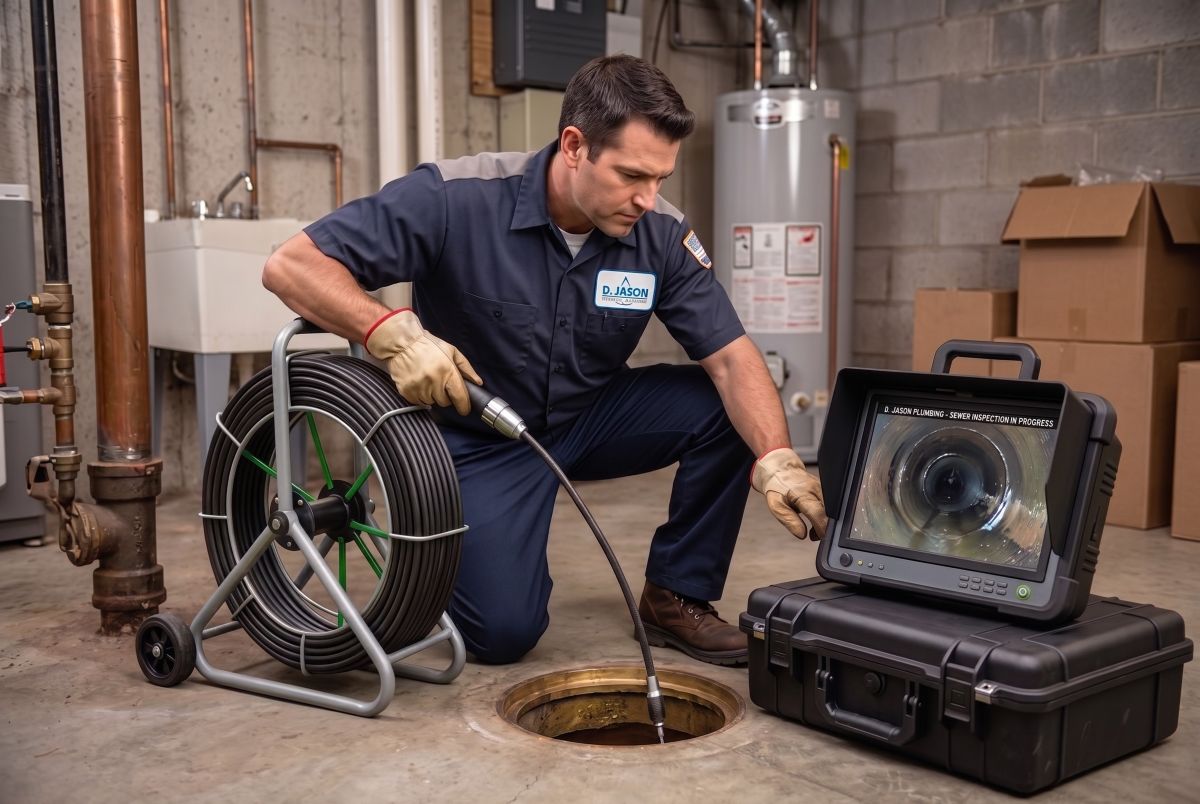
To determine the correct path forward for your home, insist on a professional subterranean CCTV camera inspection from a licensed plumbing contractor. A high-definition camera traverse will pinpoint the exact depth, material, slope, and structural state of your current line, confirming whether your property is an ideal candidate for the non-invasive power of trenchless pipe bursting or if traditional excavation is necessary to safeguard your home’s foundational drainage. Contact D. Jason Plumbing to discuss the best solution for your yard.
Reference: https://plumbingquotes.ca/blog/sewer-line-replacement-cost