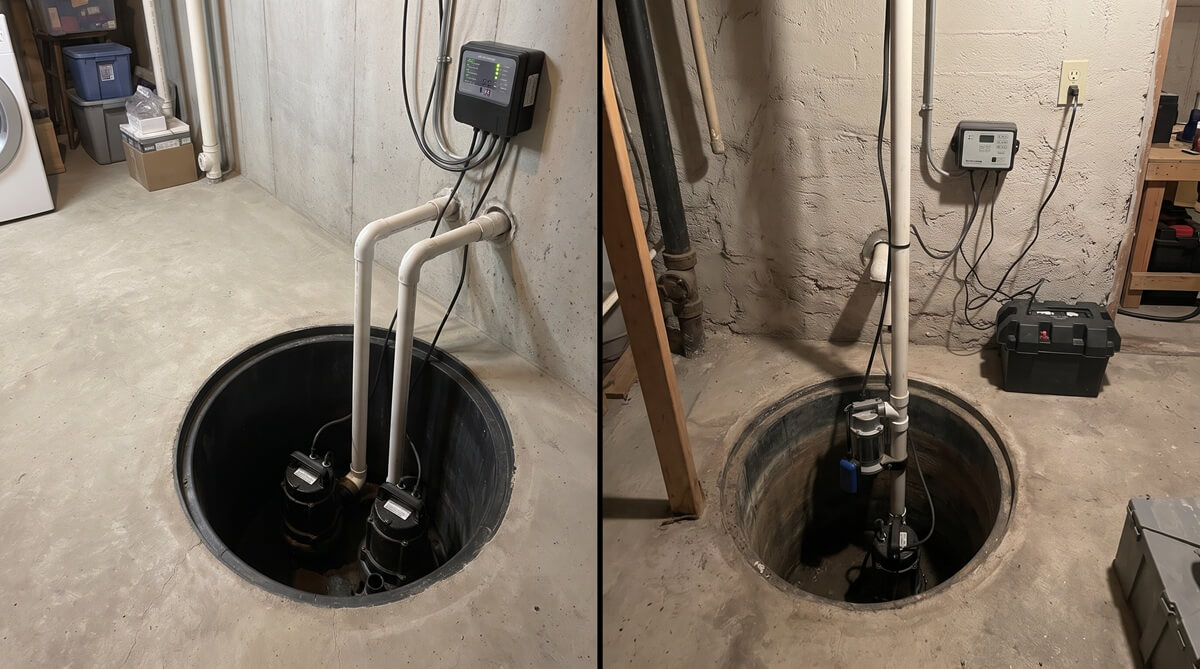
When heavy downpours strike, your basement relies on a single crucial line of defence: your sump pump system. For homeowners invested in protecting finished basements, high-value mechanical systems, or stored family heirlooms, selecting the right sump pump architecture is not merely a home maintenance chore; it is a critical property management decision.
Two popular solutions dominate the residential market today: the classic Single Sump Pump with Battery Backup and the True Dual Sump Pump System with Alternating Redundancy. While both setups aim to keep your home dry, they approach risk mitigation differently when faced with mechanical failure, massive water intake, or prolonged grid outages.
The Stakes of Flood Prevention in Southern Ontario’s Vulnerable Basements
Southern Ontario presents a unique set of hydrological challenges for residential properties. From rapid spring snowmelts in early April to intense severe thunderstorm cells during peak summer months, ground saturation levels can spike within minutes. Basements across regions like the Greater Toronto Area, Hamilton, Niagara, and Southwestern Ontario often sit on clay-heavy soils or high water tables, creating immense hydrostatic pressure against foundation walls.
When torrential rains hit, water naturally migrates toward your foundation footings. If your sump basin fills faster than your system can discharge it, or if power cuts out during a severe storm, a basement can flood in under an hour. Beyond immediate water damage restoration costs, which frequently exceed tens of thousands of dollars, basement flooding risks structural deterioration, toxic black mold growth, and denied insurance claims due to policy coverage caps or lack of proper mitigation equipment.
To prevent devastating losses, understanding the technical differences between single-pump backup configurations and true mechanical redundancy is vital.
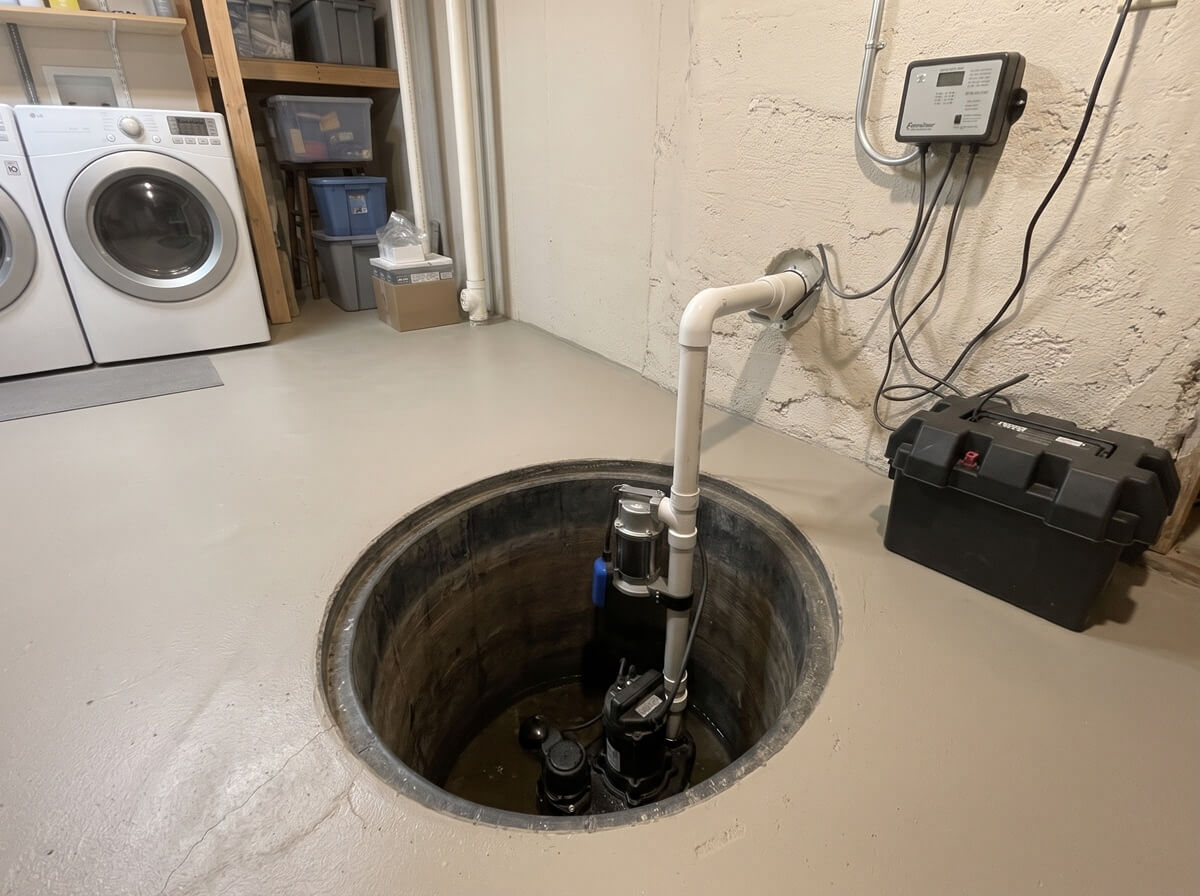
Option A: The Single Sump Pump + Battery Backup Configuration
The most widespread basement protection setup consists of a primary AC-powered sump pump paired with a secondary, lower-capacity DC battery backup pump mounted slightly higher in the pit.
In standard operation, the main primary sump pump (typically 1/3 HP or 1/2 HP running on 120V household electricity) handles 100 percent of the normal water discharge. Should the power go out, or if the primary pump’s float switch suffers a failure, the water level in the pit rises until it reaches the secondary battery backup pump’s activation switch.
Key benefits of this configuration include:
- Lower Initial Capital Investment: Standard battery backup kits are widely available and cost-effective to install.
- Dedicated Outage Protection: The battery system provides immediate, automatic takeover during grid failures.
- Basic Redundancy: Offers a secondary pump if the main unit experiences a sudden motor burnout.
However, a standard secondary DC pump typically offers lower gallons per hour (GPH) capacity than your primary unit. If heavy rain occurs simultaneously with a mechanical failure of the primary pump, a smaller backup pump may struggle to keep up with high-volume inflows.
How Long Will a Battery Run During a Real Power Outage?
A common misconception among homeowners is that a battery backup system provides unlimited protection during power outages. In reality, a standard deep-cycle marine AGM or gel battery powering a standard 12V DC pump operates on a strict energy budget.
Under continuous operation, where the pump runs non-stop due to severe groundwater infiltration, a standard battery usually lasts 4 to 7 hours. In intermittent duty cycles, running every few minutes, protection can stretch between 24 and 48 hours.
Several factors impact real-world battery longevity:
- Pumping Head Height: The higher the vertical distance water must travel to exit your home, the harder the motor works, drawing higher amperage from the battery.
- Battery Age and Chemistry: Lead-acid batteries degrade over time, losing up to 30 percent of their charge capacity after 3 to 4 years. Modern setups increasingly utilize inverter technology, allowing high-efficiency AC pumps to run off pure sine wave lithium or AGM battery banks, significantly improving runtime and pumping output.
- Severe Hydrostatic Pressure: If a storm continues past the 24-hour mark during an extended regional grid outage, a single battery will eventually exhaust its charge unless paired with an auxiliary generator or dual-battery bank.
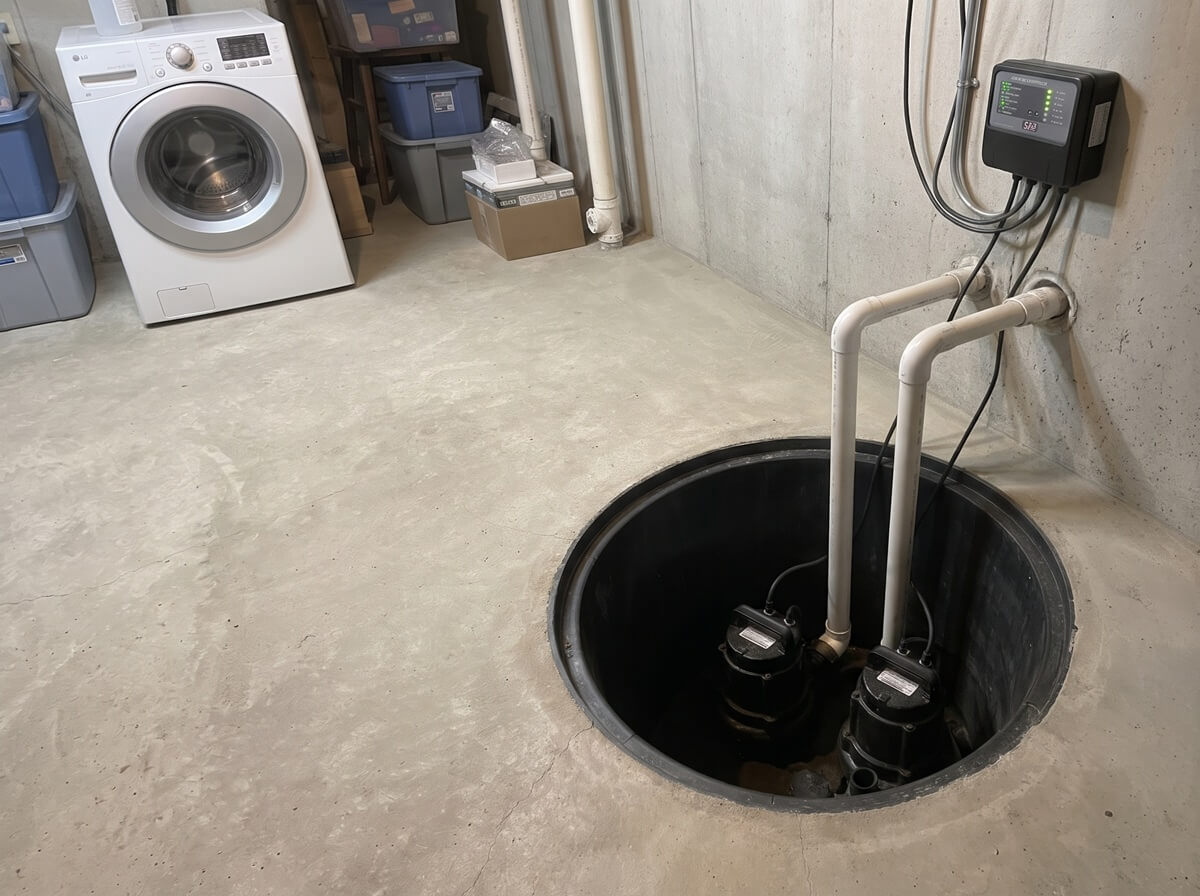
Option B: The True Dual Sump Pump System (Alternating Redundancy)
For maximum security, a true dual sump pump system utilizes two full-sized, identical high-capacity AC pumps installed in tandem inside a larger basin, controlled by sophisticated system hardware.
Instead of keeping one pump idle while waiting for an emergency, a dual system uses smart monitoring controllers that automatically alternate operation between Pump A and Pump B with every duty cycle. This balanced usage prevents mechanical seize-up, which is a common issue in idle secondary pumps, and doubles the overall operational lifespan of both units.
Key features of a Dual System include:
- Equal Pumping Power: Both pumps feature matching high-horsepower motors capable of handling maximum continuous flow rates.
- Simultaneous Operation: If incoming groundwater volume exceeds what one pump can handle, the controller engages both pumps together, doubling your total gallons per hour (GPH) capacity.
- Integrated Alarm Diagnostics: Smart control panels constantly measure amperage, pump cycles, and water rise rates, alerting homeowners via Wi-Fi push notifications or cellular alerts at the first sign of an irregularity.
The Value of Dual Float Switches and Doubling Your GPH Capacity
The weakest mechanical link in any sump system is often not the motor itself, but the switch mechanism. Traditional tethered floats can become hung up against basin walls or discharge pipes, while standard vertical mechanical switches can suffer from contact wear over thousands of cycles.
A true dual sump pump system incorporates independent solid-state or dual-float switch assemblies for each pump.
- Fail-Safe Triggering: If Pump A’s float switch sticks or fails, Pump B’s float switch activates seamlessly on the next water elevation threshold.
- Peak Flow Response: During extraordinary meteorological events, such as 100-year rainstorms or combined rapid snowmelts, groundwater inflow can outpace a single 3,000 GPH pump. By engaging two matching primary pumps simultaneously, the system ramps up output to 5,000 to 6,000 GPH or higher, rapidly lowering the basin water level and preventing overflow.
To ensure uninterrupted operation during extended severe weather power outages, a true dual system is paired either with a dedicated high-capacity inverter technology power station or an automatic standby natural gas generator.
Performance Comparison: Power Outage Security vs. Heavy Rainfall Mechanical Failure
Evaluating how each system performs under different crisis scenarios reveals distinct structural strengths and potential vulnerabilities.
Short-Duration and Extended Power Outages
During short hydro interruptions lasting under six hours, both systems offer exceptional security. A standard battery backup engages automatically via its DC battery reserve, while a dual system paired with battery inverter technology or a standby generator seamlessly maintains full operation. However, during extended regional outages exceeding 24 hours, a standard battery backup risks complete depletion without an auxiliary charging source. Conversely, a dual system tied into high-capacity inverter arrays or dedicated generators delivers sustained high-volume discharge for days.
Primary Pump Mechanical Failure
When a primary pump motor burns out or experiences mechanical failure, a standard secondary DC backup pump will activate, but it typically operates at a reduced GPH rate. In contrast, a true dual system provides complete mechanical redundant backup. If Pump A fails, Pump B immediately assumes 100 percent of the duty cycle with matching high-volume pumping capacity.
Extreme Water Inflow Conditions
During severe storms where groundwater enters the basin at extreme rates exceeding 3,500 GPH, a single primary pump assisted by a small battery backup can easily become overwhelmed. Dual systems excel under these extreme conditions because smart controllers engage both matching high-capacity pumps simultaneously, effectively doubling the discharge volume to handle massive water surges.
Switch Reliability and System Monitoring
Switch failure remains one of the top causes of basement flooding. Standard setups typically rely on basic mechanical switches that lack advanced diagnostic feedback. Dual systems feature independent dual-float switches or solid-state sensors. Furthermore, modern smart monitoring controllers continuously analyze pump health and deliver real-time app telemetry, warning homeowners of potential issues before an overflow occurs.
Evaluating Alternatives: The Water-Powered Backup Alternative
For homeowners seeking an emergency option that avoids battery shelf-life limits entirely, a water-powered backup alternative is worth noting.
These pumps use the pressure of your municipal potable water supply, utilizing the Venturi effect, to siphon water out of your sump pit without needing electrical power. For every gallon of municipal water used, the pump evacuates roughly two gallons of sump water.
Pros of Water-Powered Backups:
- Unlimited runtime during power outages as long as municipal water pressure is maintained.
- Zero battery maintenance or replacement costs every 3 to 5 years.
Cons and Limitations:
- Incompatible with Well Water: If your power goes out on a rural property using a well, your pressure tank will lose pressure, leaving the backup useless.
- Lower Flow Rates: Water-powered pumps generally offer low GPH discharge rates compared to high-efficiency AC electric pumps.
- Backflow Risks and Regulations: Requires strict installation of certified backflow preventers to avoid contaminating municipal drinking water, and some Ontario municipalities restrict their continuous use during municipal emergencies.
For most suburban and urban homes in Southern Ontario, combining a robust AC dual pump system or high-output battery inverter setup remains the gold standard for high-volume performance.
Final Recommendation: Which System Belongs in Your Home?
Choosing between a Single Pump + Battery Backup and a True Dual Sump Pump System comes down to your basement’s financial footprint and risk threshold:
- Choose a Single Pump + Battery Backup if you have an unfinished basement, low-to-moderate groundwater movement, and are looking for a reliable, budget-conscious safety net against routine municipal power flickers.
- Invest in a True Dual Sump Pump System if you have a high-value finished basement, high water table exposure, frequent hydro outages during severe weather, or want total peace of mind through complete mechanical redundant backup, high GPH capacity, and state-of-the-art smart monitoring controllers.
Contact D.Jason Plumbing Today
Protecting your foundation is an investment in your home’s structural integrity and overall value. Consult with a licensed plumbing specialist to assess your basin size, calculate your necessary vertical head and discharge requirements, and implement the optimal sump pump configuration for your property. Contact D. Jason Plumbing today to ensure you are selecting the right sump pump for your property.