
For homeowners in the Greater Toronto Area (GTA), winter is more than a season, as it brings a demanding property maintenance routine. From the lake-effect flurries sweeping across the urban core to the heavy, prolonged accumulations in northern regions like Vaughan, Richmond Hill, and Markham, managing winter precipitation requires substantial physical effort and logistical coordination.
Traditional snow removal strategies rely on early morning physical labour or monthly retainer contracts with plow operators. However, these operators often struggle to maintain rigid schedules during severe blizzards. In this challenging winter environment, automated residential snowmelt systems have evolved from an exclusive luxury feature into a practical infrastructure consideration for premium GTA homes.
The core motivation behind automating snow removal goes far beyond basic convenience. Property owners must evaluate a complex set of operational variables, structural parameters, and financial tradeoffs. Investing in a heated driveway requires analyzing several factors:
- Municipal safety bylaws and local clearing requirements.
- Sub-surface material thermodynamics and heat retention.
- The balance between significant upfront capital infrastructure costs and predictable, long-term operational expenditures.
This comprehensive evaluation breaks down the engineering, hardscape mechanics, operational costs, and long-term valuation metrics required to determine if an automated snow melt system is a justifiable asset for your Toronto property.
The Mechanics of Modern Residential Snow Melt Systems
To evaluate the financial viability of a heated driveway, it is essential to understand how modern sub-surface thermal systems operate. Rather than relying on standard manual activation, which often leads to ice formation before the surface reaches operating temperature, modern engineering utilizes highly sophisticated automated snow sensors. These specialized controllers are embedded directly into the driveway surface or mounted adjacent to it, continuously tracking ambient air temperature and atmospheric moisture levels simultaneously.
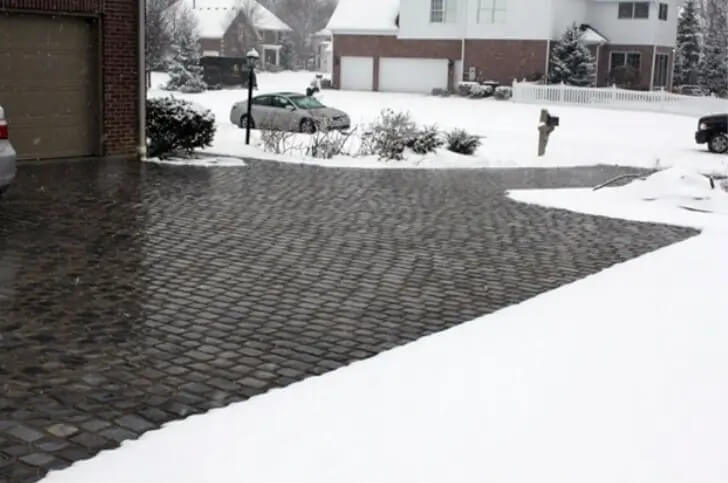
The system remains in a low-energy standby state until the temperature drops below a preset threshold, typically 1.5°C to 2°C, and moisture is detected. Once both conditions are met, the automated system triggers the thermal transfer cycle immediately, melting the first snowflakes as they hit the ground.
This preventative thermal barrier provides two main benefits:
- It prevents snow from bonding to the sub-grade material.
- It eliminates the slick layer of hard-packed ice that often forms underneath standard shovelled surfaces.
Furthermore, these advanced controllers feature configurable post-purge cycles. This keeps the heating elements active for a specified timeframe after precipitation has completely ceased, ensuring all residual meltwater evaporates safely into the atmosphere rather than refreezing into dangerous black ice.
Hydronic (Liquid-Based) vs. Electric Coil Systems
Homeowners must choose between two fundamentally distinct architectural platforms: Hydronic systems and Electric Coil systems. Both options accomplish the same core objective but operate on completely different thermodynamic and infrastructure frameworks.
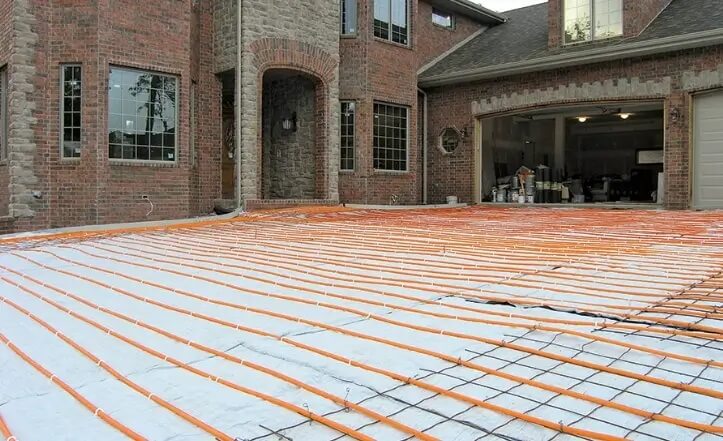
Hydronic heating systems utilize a closed-loop network of heavy-duty, cross-linked polyethylene tubing, universally recognized as PEX piping. This tubing is meticulously mapped and tied down to a reinforced structural mesh before any surface material is poured. Once activated, a specialized mechanical pumping station circulates a heated solution of water and non-toxic propylene glycol antifreeze through the sub-surface network.
The primary structural advantage of a hydronic system lies in its exceptional power source flexibility. Through dedicated boiler integration, these systems can be powered by several configurations:
- High-efficiency natural gas modulating-condensing boilers.
- Commercial-grade propane setups.
- Advanced air-to-water geothermal heat pumps.
Because natural gas historically offers a significantly lower cost per British Thermal Unit (BTU) compared to grid electricity in Ontario, hydronic systems are preferred for large surface areas, such as expansive multi-car driveways or steep, long private access ramps.
In contrast, Electric Coil systems rely on high-resistance, industrial-grade heating cables embedded directly within the driveway sub-base. When an electric current passes through these specialized alloy cables, resistance generates direct thermal energy. Electric systems require significantly less mechanical footprint because they do not require a mechanical room filled with boilers, expansion tanks, and manifold stations; they run directly out of specialized, weatherized electrical panels.
While electric installations have lower upfront capital costs and offer faster initial thermal response times, their long-term operational viability is heavily constrained by your home’s incoming electrical service capacity. Powering a standard two-car electric driveway can easily require 150 to 300 amps of dedicated electrical current. For most GTA residential properties, this necessitates an expensive, complex main service upgrade with Toronto Hydro or Hydro One, often tilting the economic balance back toward hydronic solutions.
Upfront Costs Broken Down: Excavation, Piping, and Boilers in the GTA
Installing a functional residential snow melt system is a multi-disciplinary capital infrastructure project that combines heavy civil earthworks, structural concrete or asphalt paving, and advanced mechanical plumbing. The financial commitment varies dramatically based on whether you are retrofitting an existing property or integrating the system into a planned new custom home build. For a standard residential two-car driveway in Toronto, approximately 600 to 800 square feet, homeowners can expect a comprehensive capital expenditure ranging from $28,000 to $65,000+ CAD, depending heavily on site access and chosen mechanical options.
The total capital investment is split across several specific phases and components:
- Excavation and Sub-Base Preparation: Costs $6 to $12 per square foot, covering the demolition of old material, soil grading, and gravel compaction.
- PEX Piping or Electric Elements: Costs $8 to $15 per square foot, depending on the material grade, loop spacing density, and commercial tie-downs.
- Dedicated Mechanical Boiler: Costs $9,000 to $16,000 total for hydronic setups, covering modulating-condensing units, gas line sizing, and venting.
- Controls and Snow Sensors: Costs $2,500 to $4,500 total, including pavement-mounted sensors, moisture probes, and control panels.
- Final Surface Poured Material: Costs $8 to $22 per square foot, depending on the choice of asphalt or concrete, pouring labour, and curing additives.
For hydronic systems, the most significant single upfront cost component is the dedicated boiler integration. A snow melt system cannot share a standard home heating boiler because it requires a massive, immediate injection of thermal energy to counteract freezing Canadian blizzards.
A dedicated premium modulating-condensing natural gas boiler, ranging from 150,000 to 400,000 BTU capacity, costs between $9,000 and $16,000 for equipment, gas line extensions, and mechanical room integration. Conversely, if opting for an electric coil layout, the sub-surface material costs are comparable, but you must budget an extra $4,000 to $10,000 if your property requires a main electrical utility panel upgrade to handle the increased load.
Winter Operating Expenses: What Will it Cost to Run per Heavy Snowfall?
Once the initial capital infrastructure investment is complete, the focus shifts to ongoing winter operating costs. Many Toronto property owners worry that running a heated driveway will result in unpredictable, exorbitant monthly utility bills. In reality, because these systems are fully automated and run only during active precipitation and post-purge drying windows, they operate far fewer hours per season than a standard home furnace.
Let us analyze a typical 15-centimetre, or 6-inch, heavy winter snowfall in Toronto, assuming a total system runtime of 10 hours, which includes 7 hours of active snowfall and a 3-hour post-purge drying cycle:
- Hydronic System Powered by Natural Gas: A 700 square foot driveway requires an output of roughly 105,000 BTUs per hour. Factoring in system efficiency losses, the boiler consumes approximately 1.2 therms of natural gas per hour. At current Ontario natural gas rates, this operates at roughly $1.50 to $2.20 per hour. Therefore, a heavy 10-hour storm cycle costs between $15.00 and $22.00 CAD in natural gas utility charges.
- Electric Coil System Powered by Grid Electricity: A 700 square foot driveway drawing 40 watts per square foot establishes a continuous electrical load of 28 kilowatts. Over a 10-hour storm cycle, the system consumes 280 kilowatt-hours of electricity. Given Ontario’s Time-of-Use or Ultra-Low Overnight electricity billing tiers, if the storm hits during peak daytime hours at roughly 18¢ per kWh, the operating cost is $50.40 CAD. If it occurs overnight under a lower rate tier, such as 8.7¢ per kWh, the cost drops to roughly $24.36 CAD.
When totalled over an entire Toronto winter season, which experiences an average of 10 to 15 significant snowfall events, a hydronic system costs approximately $250 to $450 annually to operate. An electric system ranges from $500 to $950 depending on timing. This shows that while operational costs are a factor, they are relatively manageable when compared to the ongoing, rising fees of professional winter plowing services.
Concrete vs. Asphalt: Material Impacts on Heat Distribution
The structural longevity and overall thermal efficiency of a residential snow melt system depend heavily on the material selected for the driveway surface. The choice between pouring concrete or laying asphalt involves analyzing structural physics, material durability, and thermal thermodynamics.
The primary engineering principle to consider here is thermal mass, which is the innate capacity of a dense material to absorb, store, and gradually radiate thermal energy. Concrete possesses a significantly higher thermal mass and superior thermal conductivity compared to asphalt.
Concrete offers several thermal and physical advantages:
- It distributes thermal energy evenly across the entire surface when the PEX piping or electric coils heat the surrounding matrix.
- It results in highly uniform melting and minimizes cool spots between the heating loops.
- It provides a rigid, highly durable encasement that protects buried heating elements from shifting or cracking under heavy vehicle loads over time.
However, to prevent cracking caused by extreme seasonal temperature fluctuations, installers must strategically place expansion joints. They must also ensure the embedded heating elements are carefully sleeved wherever they cross these structural joints.
Asphalt offers distinct advantages, primarily its lower initial installation cost and its darker aesthetic, which naturally absorbs solar radiation on clear winter days to assist the melting process. However, from a thermodynamic perspective, asphalt acts as a natural insulator rather than an effective conductor. It takes longer for thermal energy to rise through an asphalt matrix, which can increase initial system warm-up times.
Additionally, asphalt is a flexible, oil-based pavement that requires high-temperature compaction during installation. This requires paving crews to exercise extreme caution, because heavy rollers and hot asphalt mixes can easily crush or puncture exposed PEX lines or damage electrical insulation if the installation is not carefully managed. Over the long term, the regular freeze-thaw cycles of Toronto winters can cause asphalt to soften and travel around heating elements, making concrete the preferred choice for long-term system durability.
Long-Term Value: ROI on Property Upgrades and Slip-and-Fall Liability
When conducting a final financial analysis, evaluating a residential snow melt system solely through the lens of direct asset appreciation misinterprets how premium real estate is valued. In high-demand Toronto neighbourhoods such as Rosedale, The Bridle Path, Forest Hill, and Lawrence Park, a heated driveway serves as a major differentiator that elevates a luxury home’s market appeal.
While a buyer may not see a dollar-for-dollar return on the initial capital investment, a heated driveway provides a distinct competitive advantage. It functions as a premium feature that accelerates property sales and justifies a higher asking price. For specific demographics, an automated snow melt system is an exceptionally attractive feature that removes a major winter maintenance burden, especially for:
- Buyers prioritizing low-maintenance, turn-key living.
- Multi-generational families looking to protect aging parents from winter hazards.
Beyond real estate market trends, the financial protection provided by mitigating slip-and-fall liability is a major benefit. Under the Ontario Occupiers’ Liability Act, residential property owners have a strict legal duty to maintain safe access routes. Slips and falls on accumulated ice can result in costly personal injury lawsuits, rising home insurance premiums, and substantial out-of-pocket legal expenses.
For homes with steep property grades, complex north-facing walkways that receive minimal winter sunlight, or prominent public-facing sidewalks, an automated system provides reliable protection against ice hazards. It ensures continuous compliance with Toronto’s strict municipal clearing bylaws without requiring constant personal monitoring.
Contact D. Jason Plumbing
When you factor in the elimination of winter physical labour, the cost savings from avoiding chemical de-icers, which corrode masonry and destroy surrounding landscaping, and the long-term protection of your driveway surface, the return on investment becomes clear. It shifts from a simple calculation of utility costs to a comprehensive investment in safety, property protection, and lifestyle convenience.
To ensure your home is being maintained properly during the cold months, contact D. Jason Plumbing today.
Sources
https://neinstein.com/news-blog/legal-news/ontario-60-day-slip-fall-notice-rule